


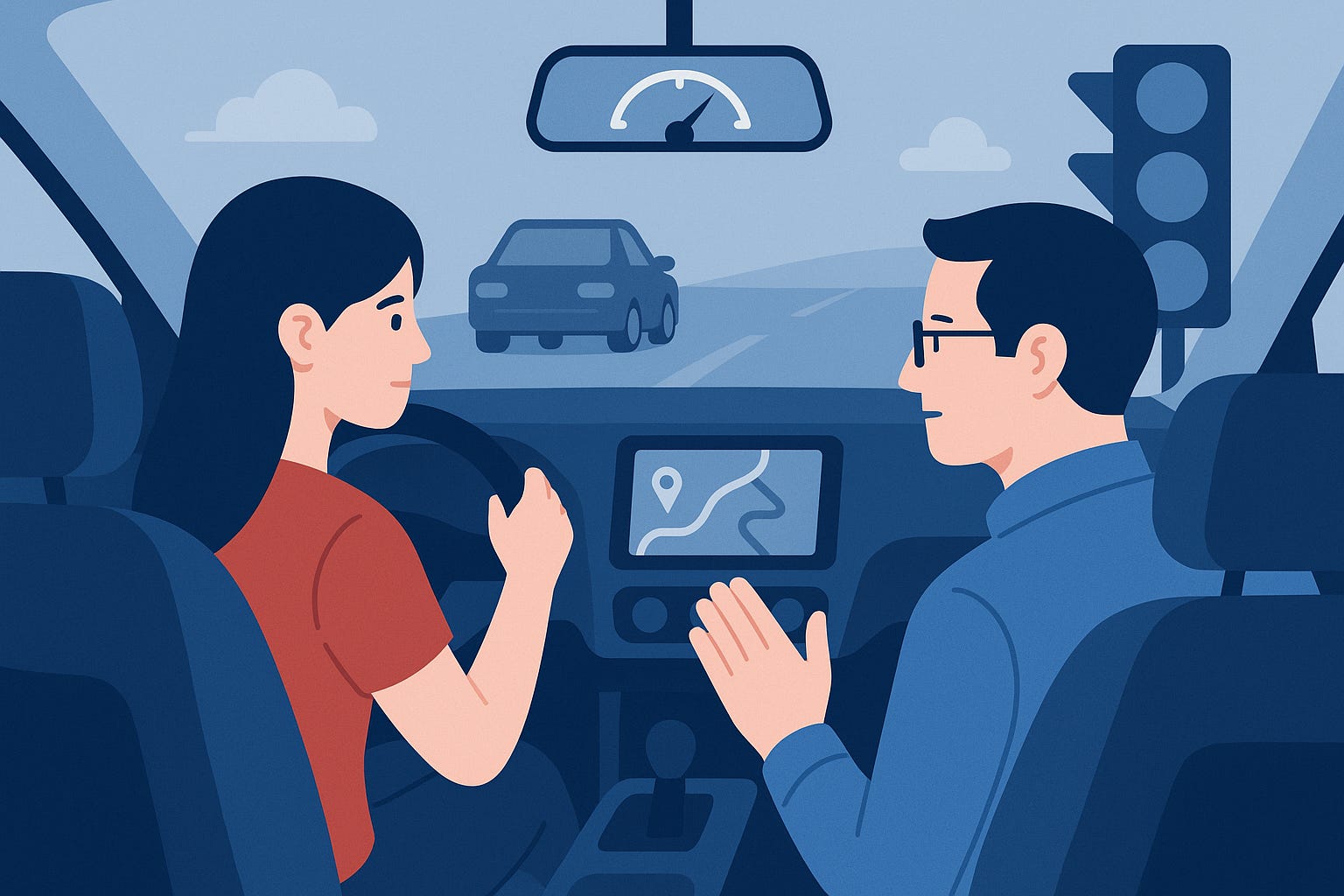
Teaching my 17-year-old to drive taught me more about coaching than any book ever did. I love driving. I’m experienced, confident, and probably have more kilometers under my belt than most people I know. But sitting in the passenger seat, watching someone you care about take the wheel for the first time, is something else.
You suddenly have expertise without control. You see mistakes coming before they happen and you can’t intervene physically. You can only guide. And you have to do it while staying calm in situations where your own instincts are screaming.
We had a few unpleasant moments. Nothing dangerous. No damage. But there were times in the middle of an intersection where things went wrong, people honked, hands waved, and my daughter fought tears. These were the exact moments where instinct told me to raise my voice. Instead, I took a breath. I talked her through the situation slowly and clearly. We got out of it. She recovered. And she learned.
Over the last weeks, something important happened: she became a better, more confident driver than she ever was coming out of driving school. And all of that started with one decision on my side: control myself first.
This is not about driving. It’s the architecture of any mentoring relationship.
Teaching under pressure starts with the teacher, not the learner
The hardest part of mentoring isn’t transferring knowledge. It’s managing yourself when the learner struggles.
Software developers see this every day:
pair programming with a junior who gets stuck on a simple bug
watching someone misuse a tool you know inside-out
seeing a clean architectural idea turn messy
reviewing a pull request full of avoidable issues
onboarding a colleague who keeps asking the same questions
These situations trigger the same internal tension as sitting in a passenger seat:
you know exactly what to do, but you need them to do it.
Emotional self-control is what transforms these moments from frustrating to productive.
Learners don’t improve under irritation.
They don’t grow when mistakes are met with sighs, eye rolls, or criticism masked as “honesty.”
They grow when the environment remains stable.
In driving and in software, your emotional presence becomes the runtime they operate in.
Why staying calm works: the psychology behind the behavior
A few mechanisms explain exactly why your presence matters more than your instructions.
Emotional contagion
Humans mirror the emotional state of the person next to them.
If the senior dev in a pair session sighs or tightens their tone, the junior tightens too.
Their cognitive resources drop. They stop thinking deeply because they start thinking defensively.
In my daughter’s case, my calm tone kept her functional.
In a coding scenario, it keeps someone experimenting instead of freezing.
Fight-or-flight threshold
One sharp comment during a pair programming session can push a learner into “I’m messing up” mode.
After that, their working memory collapses. They type slower. They stop asking questions. They just try not to look stupid.
The same biology applies to driving.
Self-control keeps the learner in the cognitive zone, not the survival zone.
Psychological safety
When the senior developer reacts calmly to mistakes, the team becomes a place where people try things.
When every slip triggers tension, people hide their uncertainty.
As a mentor, you get to choose whether people tell you the truth or tell you what they think won’t upset you.
Self-efficacy
Every beginner programmer builds a mental model of “Can I do this?”
This belief determines how quickly they ramp up.
If every little mistake gets a sharp correction, the belief collapses.
If every misstep is treated as normal and solvable, the belief grows.
My daughter didn’t just learn car control.
She learned self-control under my control.
The same dynamic exists when guiding developers.
The curse of knowledge
Experts forget how it feels to not know.
This makes them impatient.
Self-control is the antidote.
It forces you to slow down enough to remember that learning involves friction.
Pair programming is especially sensitive to this. The mentor must constantly suppress the instinct to grab the keyboard and “just do it.”
Every time you don’t, you give the learner space to build their own mental model.
Expertise without self-control creates damage
Most technical leaders don’t intend to discourage.
But it takes only one frustrated pull-request comment, one visibly annoyed reaction in a call, or one sarcastic “we’ve already discussed this” to set a learner back weeks.
The parallel to driving is clear:
My expertise can either protect or intimidate.
It depends on my emotional regulation, not my technical depth.
One can be brilliant and still be a poor teacher.
One can be calm and become a mentor people actively seek out.
Emotional self-control is a foundational layer of the mentoring architecture
Software development is full of fast decisions and small moments of tension.
Architecture reviews, debugging sessions, production incidents, junior onboarding; all of these rely on one invisible skill: the mentor’s ability to create a stable environment in unstable situations.
Think of learning as a system architecture:
attention is the compute resource
confidence is the memory bandwidth
safety is the network layer
your emotional state is the operating system
If the operating system crashes, nothing above it runs reliably.
Emotional self-control is not a soft skill.
It’s the stability layer the whole mentoring stack depends on.
When you stay calm, others learn to stay calm
My daughter didn’t just learn to drive.
She learned how to handle pressure.
She learned that mistakes are part of the process.
She learned that staying composed works better than collapsing.
That’s the real transfer.
In software, the same happens when a senior developer remains steady during confusion, bugs, outages, or tough discussions.
People learn to debug without panic.
They learn to ask for help early.
They learn that the team has space for imperfection and growth.
I didn’t just guide her actions.
I modeled the emotional regulation she is now adopting herself.
Self-control is the mentor’s multiplier
The deeper truth is simple:
You cannot teach well if you cannot regulate yourself.
You cannot mentor well if you cannot absorb tension.
This applies in driving, in pair programming, in architecture reviews, and in any professional relationship built on guidance.
A mentor who stays calm expands the learner.
A mentor who loses control shrinks them.
Choose who you want to be in the passenger seat. At home and at work.
I'm not an adept of the pair-programming. Okay, the pair-programming described here, in the post, makes more sense as it involves a senior and a junior and aims at teaching and training the junior.
But this isn't the most common way that pair-programming sessions happen in organizations.
It is common knowledge that management doesn't understand much of what programmers do and,
more often than not, pair-programming sessions are used as reporting methods. They don't aim at facilitating the knowledge transfer but to increase the control and to put more pression on people, especially in places where the remote work is effect.
Otherwise, as someone who belongs to a generation where teachers, trainers, coaches and other gurus where rather severe and authoritative, I could only agree to the concept of pedagogical requirements alied to the kindness.